




The American cancer researcher Prof. Peter Duesberg died in January of this year at the age of 89. However, it’s not for his work in discovering the role of oncogenes in the growth of cancerous tumours that he will best be remembered; since the 1980s, Duesberg’s name has been synonymous with attempts to pour doubt on the link between human immunodeficiency virus (HIV) infections and acquired immunodeficiency syndrome (AIDS).
For many, it will come as a surprise that denial of HIV’s role in causing AIDS could persist almost 50 years since the start of the AIDS epidemic. Sadly, Duesberg’s death does not herald the end of that misguided and dangerous movement: the Duesberg Hypothesis on AIDS lives on, in the shape of the world’s most popular podcaster – and repeated AIDS denier – Joe Rogan.
Joe Rogan and AIDS denial
In November 2025, Joe Rogan released episode 2,411 of his wildly successful podcast, The Joe Rogan Experience. In it, he spoke to security expert and self-styled vaccine researcher Gavin de Becker, and through a meandering three-hour conversation that has been viewed more than a million times on YouTube, the pair talked about Covid vaccines, swine flu, SIDS, autism, the tetanus vaccine, the polio vaccine, the measles vaccine, and the fact that Adolf Hitler didn’t really shoot himself.
Early in the conversation, Rogan raised the issue of AIDS, and his belief that HIV is merely a “passenger virus”, too weak to cause any harm to people – so weak that even newborn babies can fight off an HIV infection without any treatment (this isn’t true – there are babies who have tested positive on birth but negative later, but these were almost certainly the result of initial false positives). Instead, according to Rogan, people with AIDS-compromised immune systems were a result of the party lifestyle of the 1980s gay clubbing scene:
“The vast majority of the people that got air-quotes AIDS all were hardcore drug users. They were these partiers in the gay community… And these guys are burning it at both ends. And when you do that, sometimes you fucking die. Sometimes your immune system gets crashed”
While it’s true that participants in the 1980s gay party scene might have often had late nights and used recreational drugs, these were not the cause of AIDS – we know that, because there was no shortage of drug use among heterosexual clubbers in the 1980s, who experienced fewer cases of AIDS. Also, use of recreational drugs hasn’t gone away… but the widespread reality of AIDS as a death sentence has. The reason is clear: there was a virus circulating among sections of the population, which was eventually curtailed with effective treatments and then brought under control via a mixture of public health messaging and preventative pharmaceuticals.
Part of the reason HIV was able to circulate among the gay male community for so long was the stigma society placed on that community – stigma that Rogan explicitly perpetuated in his conversation with de Becker. Rogan repeated the myth that AIDS patients’ respiratory symptoms were caused by the prominent use of amyl nitrate, or poppers, in the gay community – in reality, the effects of HIV in decimating the immune system left AIDS patients susceptible to extreme infections by viruses that otherwise-healthy immune systems could fight off, including respiratory viruses.
Rogan even repeated the false notion that AIDS was a disease specific to the gay community:
“Why did it never make its way to the heterosexual community? If it’s really a sexually transmitted disease that’s so unbelievably contagious… how come it never really had any meaningful transition to the heterosexual community?”
The fact is, while AIDS did disproportionately affect gay men (HIV is more likely to spread through anal sex than via vaginal or oral sex), it is absolutely untrue that there was no transition to the heterosexual community. For one, the gay and heterosexual communities are not distinct; they’re not even sexually distinct. Men who have sex with men sometimes also have sex with women. In fact, according to AIDS Map from the Terrence Higgins Trust, 62% of new HIV diagnoses in the UK in 2024 came from heterosexual sex – outstripping the infection rate in men who have sex with men, partly because the heterosexual population is larger, but also because the message around the importance of safe sex has been received so effectively in the gay community.
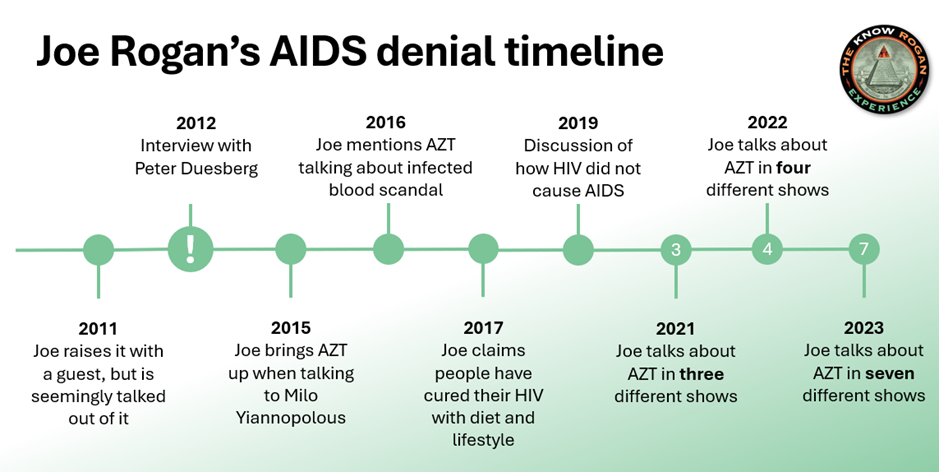
Why did the world’s most popular podcaster believe these extraordinary – and comprehensively outdated – things? In 2012, Joe Rogan interviewed cancer researcher and prominent AIDS denier, Prof. Peter Duesberg.
Prof. Peter Duesberg
After finishing a PhD at the University of Frankfurt, Peter Duesberg was offered a position at the University of California, Berkeley in 1964, to study the role of viruses in the development of cancer. In 1971, he sequenced the genome of the Rous sarcoma virus (RSV), identifying a gene in the chicken virus that caused rapid, unchecked cell growth when inserted into the host genome. A gene called src (spoken as ‘sark’). This was the first oncogene to be discovered and was soon followed up by work from Duesberg’s colleagues, identifying an analogous src gene in human cells.
But Duesberg’s long-acknowledged contrarian streak saw him turn his back on his own discovery – a finding that had secured him international acclaim, and tenure at the age of 36 – in favour of a 1914 theory from German scientist Thodor Boveri.
Boveri had noticed that cancer cells contained an abnormal number of chromosomes, a trait called aneuploidy. This, Duesberg believed, was the true cause of cancer – rather than viruses, or genetic mutations. While it is true that most cancer cells exhibit aneuploidy, researchers have argued this comes as a consequence of cancer, rather than a cause – once a cell is affected by a virus or hit by a mutation, it can’t reproduce healthily and aneuploidy can result.
Duesberg didn’t just reject the role of viruses in causing cancer – he went further, stating that no retrovirus could cause harm to humans. According to Duesberg, retroviruses (whose genomes consist of RNA rather than the more common DNA template) have an evolutionary imperative to be harmless, “because they depend on viable cells for the replication of their RNA from viral DNA integrated into cellular DNA”. This belief would send him crashing headlong into the defining health crisis of the 1980s: the AIDS epidemic.
The AIDS epidemic
The first recorded AIDS patient in America was a teenager in St Louis in 1969, who developed Kaposi’s Sarcoma (KS) – a type of cancer that usually occurred in ageing men of Mediterranean ancestry, rather than young African-American men under the age of 20. At the time, doctors were confused as to how this came about, but retrospective tissue analysis has shown their condition was a result of having contracted HIV, which had caused AIDS.
KS became a common symptom among AIDS patients, with their compromised immune system leaving them unable to fight off the herpes simplex virus that can cause KS. However, prominent cancer specialist Professor Peter Duesberg disagreed with the hypothesis that a virus can cause cancer, or that any retrovirus can harm a human being. It was impossible, therefore, for HIV to be the root cause of AIDS.
In 1987, Duesberg wrote his now-notorious article in the journal Cancer Research, Retroviruses as Carcinogens and Pathogens: Expectations and Reality, where he explained that HIV is nothing but a “passenger virus” – the term explicitly used by Rogan, nearly 40 years later. According to Duesberg, HIV was present in AIDS patients only because their immune system was unable to defeat it, as the immune systems of healthy patients routinely did, and therefore the “AIDS virus could be just the most common occupational infection of those at risk for AIDS”.
The Duesberg Hypothesis
Given his unshakeable belief that HIV was a weak and inconsequential bystander in the human body, Duesberg had to find something that could account for the tens of thousands of people who were dying from AIDS. As such, the Duesberg Hypothesis was born, attributing the immune deficiencies of AIDS to the lifestyles of gay men in the 1980s – late nights, sexual promiscuity, recreational drugs, and regular use of poppers.
Obviously, the Duesberg Hypothesis couldn’t account for the large number of cases identified in Africa – which, in the 1980s, wasn’t as hospitable to the homosexual community as New York’s East Village. This wasn’t difficult for Duesberg – he explained that there is no AIDS in Africa, merely a case of the CDC and WHO “manufacturing contagious plagues out of noninfectious medical conditions”, such as malnutrition and unclean drinking water. This AIDS “myth”, he claimed, was egged on by the media in order to help secure funding for bogus AIDS initiatives, and supported by local doctors who were paid to keep up the pretence.
Rather than being dismissed, Duesberg’s ideas were taken up by other AIDS deniers of the time – including by Thabo Mbeki, who was South African president from 1999 to 2008. Mbeki appointed Duesberg as an advisor to lead their AIDS policy in 2000 and, as a result, an estimated 300,000 South Africans died.
Not that Duesberg accepted those figures. In 2009, he published an article in Medical Hypotheses, HIV-AIDS hypothesis out of touch with South African AIDS – A new perspective, denying that his advice had led to any deaths in South Africa, nor anywhere else. According to reviewers, the paper consisted of cherry-picked data alongside statements taken completely out of context.
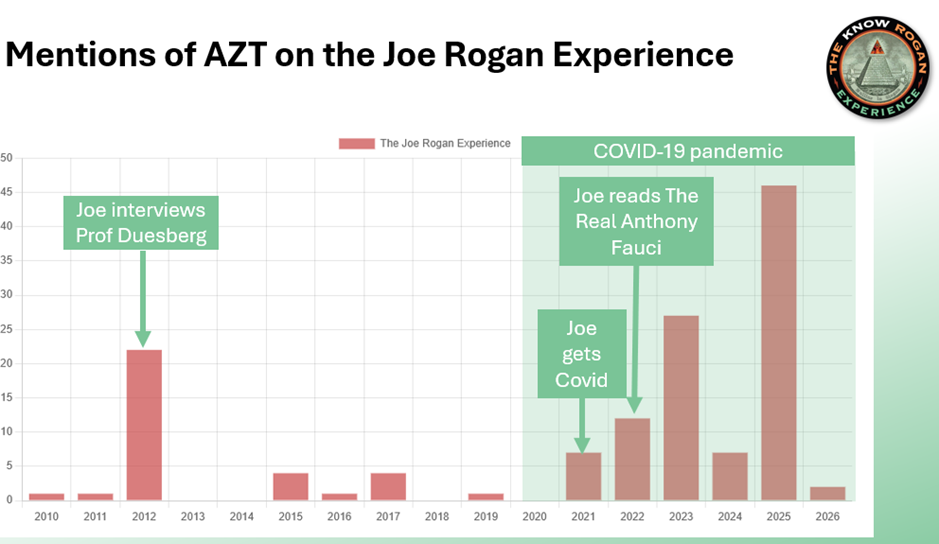
After investigation, the journal retracted the article, but Berkeley took no further action and Duesberg remained a tenured professor – a position he held when he was interviewed by Joe Rogan for his podcast in 2012, in an episode that remains available on Spotify to this day. It would be a conversation that would set Rogan on the path to becoming an all-out AIDS-denier.
Joe Rogan and AZT
The evolution of Rogan’s AIDS denialism can best be tracked through mentions on his show of one further element of the Duesberg Hypothesis – one that Rogan clearly took to heart. At the height of the AIDS crisis, medical researchers worked hard to find a treatment that could mitigate the disease’s effects and prolong healthy lives. They soon settled on a little-known cancer treatment: zidovudine, or azidothymidine (AZT).
AZT had originally been developed in the 1960s as a treatment for cancer. The theory was that the drug would be able to insert itself into the DNA of a cancer cell and disrupt cell division as the cell tried to reproduce. Unfortunately, it proved ineffective: it simply wasn’t good at binding to cancer DNA. However, initial trials during the AIDS crisis showed that AZT was 100 times more effective at binding to an enzyme produced by HIV than it was to cancer cells’ DNA replication machinery and so the first antiretroviral medication to combat HIV was born.
However, if you were a regular listener to the Joe Rogan Experience, this is not the story you would be familiar with. During his interview with de Becker, Rogan claimed:
“AZT was a chemotherapy medication that they had to stop using because it was killing people quicker than the cancer was killing people… it had already been approved and they could just push them through quickly and they were very profitable.”
This is simply not true. There were no legions of cancer patients whose lives were cut short by AZT, because AZT never made it out of the lab and into hospitals. Where did Rogan get the notion that AZT had been deadly? It was a central pillar of the Duesberg Hypothesis. In his 1996 book “Inventing the AIDS Virus”, Duesberg described AZT as “dangerously toxic”. Duesberg’s evidence for this claim, as science writer Jonathan Jarry discovered when following up on citations, was a book from AIDS denialist Jon Lauritsen, who provided no evidence for the statement.
In their 2012 interview, Rogan and Duesberg talked extensively about the harms of AZT, though Rogan later admitted that the pushback the conversation received gave him pause for thought – reasoning that it might be unlikely that Duesberg is correct on this issue while every other professional in the field is wrong. As a result, he backed off discussions of AIDS, mentioning AZT in just four further interviews across the next seven years. It seemed like AIDS denial was an idea Rogan had flirted with, even entertained by having a prominent AIDS denier on the show. But between the backlash from his audience and the pushback from other guests, he’d reasoned his way either out of the belief, or out of expressing the belief in public – except when talking to someone who might also agree.
Then in 2021, something changed, and Joe began to raise the deadly nature of AZT with his guests more and more – on three shows in 2021, four shows in 2022, and seven shows in 2023. What sparked this renewed enthusiasm for a conspiracy theory from four decades prior?
Joe Rogan contracted Covid.
In 2021, Rogan posted a video on social media explaining that he’d tested positive for Covid, and that he was treating himself with a regime of ivermectin and supplementation. The pushback he received was global, with CNN featuring his video in their news bulletins. Rogan insists CNN applied a filter to the video in order to make him look sicker, and mocked him for taking ‘horse dewormer’. In reality, the video discolouration was far more likely a result of differences in image encoding between devices, with Apple devices rendering the HDR visuals in Rogan’s original post differently.
Regardless, the effect on Rogan was severe, hastening his radicalisation into more extreme health beliefs. In subsequent interviews, he explains that he’d managed to square the circle of his prior objection: is it possible that all of the other health professionals could be wrong about AIDS? Absolutely – after all, how many health professionals pushed the Covid vaccine, which Rogan was sure had been proven to be deadly, and how many of them mocked him for taking ivermectin?
Already firmly now radicalised along the road to health extremist, Rogan needed one final push to go all-in on AIDS denial… and in 2022 that push arrived in the form of a book: The Real Antony Fauci, by Robert F. Kennedy Jr.
Robert F. Kennedy Jr and AIDS
“The Real Anthony Fauci” is almost 480 pages long, with more than a fifth of those pages dedicated to resurrecting AIDS denialist arguments, including directly quoting the work of Peter Duesberg. Kennedy writes about the “orthodoxy that HIV alone causes AIDS”, and the “theology that HIV is the sole cause of AIDS”. He writes about how no one has isolated the HIV particle – echoing the ‘Koch’s Postulate’ argument that was also used by some to deny the reality of the SARS-CoV-2 virus that causes Covid.
The book accuses Dr Anthony Fauci – the public face of America’s Covid response – of having abused his power and position for 30 years, stretching back to the AIDS epidemic, when Fauci had been one of the country’s leading researchers. This was music to the ears of the world’s most popular podcaster, whose hatred of Fauci had been cemented in that backlash to Rogan’s use of ivermectin and his repeated scaremongering about the Covid vaccine. To Rogan, Fauci had masterminded the use of AZT on AIDS patients, in the full knowledge of how deadly the drug would be, in order to make money for pharmaceutical companies… pocketing a tidy profit for himself along the way.
The book had a colossal impact on Rogan – he has raised it in at least 30 different episodes, starting on Christmas Eve 2021 and spanning interviews with Bill Maher, Gavin de Becker, Aaron Rodgers, Russell Brand, Aseem Malhotra, and indeed RFK Jr himself. The book has become the new bible of AIDS denialism, penned by the man now in charge of America’s Health and Human Services.
It has also cemented Joe’s belief that, unequivocally, HIV is a weak virus that can’t harm people, but the drug companies came along and forced AZT onto people, killing them in the process, just to make money. And the doctors all agreed to cover that up in exactly the same way they all agreed to turn a blind eye to the many provable harms of the Covid vaccine; because it’s profitable for them to do so.
The resurgence of AIDS denial?
Joe Rogan is without question the most influential broadcaster in the modern alternative health ecosystem; Robert F. Kennedy Jr occupies one of the most powerful roles in the US healthcare system. Together, they hold outsized roles and influence on the health of Americans and people elsewhere, yet they are arm-in-arm bringing 1980s-era AIDS denialism back into the mainstream discourse. Worse still, these discussions happen at a time when the realities of the AIDS crisis are beyond the living memory of many in their audience.
This is a threat we should take seriously, just as we previously saw signs that the flat-Earth movement we once thought dead and buried could return with renewed vigour, and just as the antivax movement we thought had ended in the 2010s came back with a vengeance in the 2020s.
Peter Duesberg’s life saw him responsible for the deaths of hundreds of thousands of people, given the respected position of influence he had achieved and the political connections it afforded him. He might be dead, but his legacy more than lives on in RFK Jr and Joe Rogan.