



This article originally appeared in The Skeptic, Volume 7, Issue 1, from 1993.
Hanging in my living room is an American advertising poster from sometime in the late nineteenth century. It hangs in my house largely because of the wonderful artwork: a lovely, angelic, round-cheeked young girl, with blue eyes and curly blonde tresses and rosebud lips.
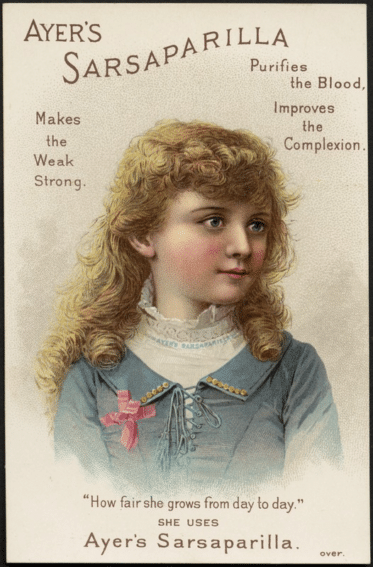
A vision of virginal Victorian virtue, the epitome of youthful innocence and beauty, a paragon of health and rectitude, she gazes serenely into the distance, head turned slightly to profile in a posture that conveys wonder and hope and a guileless and immaculate strength. A slight flush of rose in her cheeks reveals her energetic enthusiasm for life, for this child faces each new day with eager confidence. Her eyes betray no hint of worry or fear; she has never known disease or suffering.
In this painting is encapsulated everything a loving parent could possibly hope for his children. The artist – totally unknown, of course – had an enormous talent: the ability to distil the dreams and hopes and grandeur of a proud and growing culture from a palette of oil colours onto canvas.
The portrait, naturally enough, takes up most of the poster: near life-size head and shoulders of the girl centred against a neutral background. Across the top, in tastefully bold-faced letters drawn in an eye-pleasing, jaunty calligraphy, not too large, not too bold, not too gaudy, is the name of the now-defunct American product Ayer’s Sarsaparilla. In the upper right and upper left corners, in slightly smaller, more sedate print, are the phrases ‘Makes the Weak Strong’ and ‘Improves the Complexion, Purifies the Blood’. Across the bottom is the slogan:
‘How fair she grows from day to day.’
She Uses
AYER’S SARSAPARILLA
How quaintly absurd we find such claims today, for a simple beverage of mere flavoured water once dispensed as a ‘tonic’. The sophisticated citizen of today would of course scoff at such pretensions, even if truth-in-advertising laws let them slip through. We know better than to place our faith in wild claims of health and vigour from ordinary foods and beverages, and would no more believe that a common soft drink ‘Purifies the Blood’ than that Irn Bru is actually made from girders. We can smile at the naive charm of those simpler times, seeing through such transparent attempts to manipulate us as easily as a modern ten-year-old dispels the myth of Father Christmas.
Nowadays we would never be taken in by snake-oil incantations and absurd assertions from fast-talking medicine show hucksters. Today, people are vastly more aware, more perceptive than those simple-minded bumpkins of yore. We’re seasoned, sharp and cynical, educated, worldly.
We know about health and medicine and nutrition because there are thousands of books and magazine articles, talk show interviews and free government pamphlets, concerned co-workers and relatives and even complete strangers on the street to explain it to us. We can’t get through a day without being told a dozen times what’s truly healthful and what to avoid; we’re bombarded, lambasted, inundated with endless volleys of wellness programmes and organic vegetables, workouts and skin care, vitamins and minerals and high-fibre, low-sodium alternatives.
We monitor our intake of caffeine and calories, sugar and sodium, and we scrutinise our cholesterol level; we abhor MSG and eschew carcinogens. We aerate, chlorinate, and fluoridate; we exercise and aerobicise. In even the smallest towns can be found a cornucopia of organic bean curd, hydroponic tomatoes, hand-made marmalade and high-protein low-fat tofu. In short, we are the most health conscious, medically aware, biologically in-tune society that mankind has ever produced, and no one could ever be deceived by so obvious a canard as ‘Purifies the Blood’.
These days when advertisements proclaim that seemingly ordinary products will enrich our lives and ensure our health, we know that they can be believed, because cleancut, smarmy, bespectacled men with straight white teeth and conservative ties and white smocks stand before us, clutching clipboards like stone tablets handed down from the mount by the god of scientific scrutiny, with actual factual objective reports that prove it to be so.
Television advertising is awash in a veritable Sargasso Sea of graphs and charts and diagrams and reports, from medical experts, dental authorities, trained nutritional specialists and ubiquitous independent study teams, demonstrating to us with unimpeachable testimony that the products offered to us are blessed and beneficial. Keen scientific minds are diligently and tirelessly at work performing elaborate research, writing books, giving interviews, and providing a steady, lifegiving stream of facts and statistics to keep us healthy and prolong our lives.
A bowl of bran breakfast each day will add years to your life. The right facial cleanser will actually slow the aging process. Mothers who care about their kids would rather die than feed them the wrong brand of peanut butter. A simple shot glassful of cough syrup will eradicate a multitude of symptoms. Chicks dig guys who use tartar control toothpaste. The nutritionally correct choice of bread will build your body in a baker’s dozen ways. Just one of these pills will cause your body to burn away as many calories as if you’d run a marathon-and it’s COMPLETELY SAFE!
Indeed, you take your life in your hands if you use a product that isn’t doctor tested, clinically proven, medically effective, nutritionally beneficial, dentist approved and scientifically validated.
Before the advent of television, it was easy for advertisers to dupe an unsuspecting public because reality could be modified or even fabricated by professionals who specialised in creating specific images. The angelic young girl on my antique sarsaparilla poster is an artistic creation, an idealised representation brought into existence solely for the purpose of selling a product. But today, the electronic marvel of television brings us visible reality, people who actually exist and who have clearly known the amazing benefits of the products they offer us. The faithful scrutiny of the camera brings the truth into our homes.
Yes, gone are the days of primitive hucksterism and those quaintly transparent claims of health and vitality from ordinary food and hygiene products. Health awareness has come of age. ‘Purifies the Blood’ indeed!