Michael Marshall is the project director of the Good Thinking Society and president of the Merseyside Skeptics Society. He is the co-host of the Skeptics with a K podcast, interviews proponents of pseudoscience on the Be Reasonable podcast, has given skeptical talks all around the world, and has lectured at several universities on the role of PR in the media. He became editor of The Skeptic in August 2020.
Recently, claims from the Bible Society that Gen Z had undergone a “Quiet Revival” in their Christian faith were revealed to not only be false, but the fraudulent nature of the data on which such claims were based also showed deepening flaws in the online polling industry. Increased religiosity is not the only superstition that has been levelled at today’s youth because, mere weeks after the retraction of the Quiet Revival study, a Guardian headline noted a growth in Gen Z psychic belief:
The psychic generation: why do a third of gen Z believe they have extrasensory perception?
The headline was part of the Guardian’s Life and Style “Pass notes” section, which are characteristically tongue in cheek; articles are commonly written as a dialogue between the column and its author, replete with jokes poking fun at the topic in hand. Among the obvious “I don’t need to explain it if you’re psychic” jibes, they do discuss the bones of the story:
Of course I’m not psychic. Nobody is psychic. Ah, now I understand the problem. You’re old. Pardon? You’re old, and that’s why you’re not psychic. A third of gen Z is psychic. That cannot be true. OK, fine. According to new research, 30% of gen Z believe they are psychic, which is the same thing. It isn’t the same thing at all! Hey, don’t go round invalidating other people’s belief that they possess the power of extrasensory perception.
The article then goes on to explain the evidence upon which the claim rests, in the form of a recent Talker Research poll of 2,000 American adults, which found that “while 19% of Americans believed themselves to be ‘basically psychic’, that figure rises to 30% among gen Z respondents”.
Notably, the grounds for psychic ability were how often respondents felt they had experienced a “psychic moment”, with Boomers experiencing one psychic moment per month, and Gen Z doubling their supernatural output with two psychic episodes per month. However, the research wasn’t claiming a widespread ability to read minds or speak to the dead: ‘psychic’ was defined as “being able to predict how situations will play out and knowing when things feel a bit off”. The Guardian understandably concluded that this is not evidence of extrasensory talent, but may instead merely be basic pattern recognition and a sensitivity to nuance, concluding:
…young people are surrounded by so much endless economic instability, climate anxiety and political volatility that they are soothed by anything that might give them the illusion of control.
So, not psychic, just tuned into the chaotic times we live in, and responding accordingly, with the Guardian concluding that it’s best not to “subscribe to the modern resurgence in unscientific beliefs” because they provide ground for conspiracy theories “that seek to undermine authoritative objective truth.” And I agree with that conclusion, at least, but I think there’s more to this story.
For one, the Guardian aren’t the only ones to cover this story – I found it promoted uncritically by a website called “StudyFinds”, which features news about things that have been found in a study. As in research, not as in the room in a posh house where the desk and all the books are. StudyFinds describes themselves as a site started by an experienced journalist to offer “a true hub for the general public to find new studies in an easy-to-read, digestible format without all the jargon”, and to “make science accessible without sacrificing accuracy.” They even proclaim a commitment to transparency and accuracy:
It’s important for readers to know who is behind a study, how many participants it involved, the demographics of the participants, limitations, whether results are causal or observation, who funded the research, and anything else that doesn’t always get reported on. Moreover, links to the sources and the journal articles are so necessary — and many mainstream sites refuse to link to other sites. This level of transparency is paramount for research reporting.
And I agree, I’ve always said it’s worth looking at who created the study you find cited in the papers, and what limitations there are to the research. StudyFinds explains that they use at least three different LLMs to analyse each study, and they then verify those findings:
“In 2024, we added a feature to mark posts as “Verified,” indicating they were reviewed and vetted by a human member of the StudyFinds editorial team.”
So, StudyFinds gave this Gen Z psychic study a verified status, which means we should place some trust in their outline of the study’s findings and limitations. They explain:
“The figures come from a Talker Research poll of 2,000 American adults, which set out to map how everyday people use intuition in their decision-making. Across the full sample, 19% said they consider themselves psychic. Another 71% said they rely on intuition at least sometimes. Only 11% dismissed the concept entirely. Over the past year alone, the average respondent reported 18 moments they’d chalk up to some kind of psychic flash…
Gen Z leads the pack by a wide margin. Thirty percent of Gen Z respondents consider themselves psychic, and they report roughly two intuitive moments per month, double what baby boomers say they experience. Millennials and Gen X fall somewhere in between, though each generation has its own specialty.”
As for limitations of the study, and who might be behind it, StudyFinds is sadly lacking in skepticism, though they do report that:
The findings come from an online poll of 2,000 American adults with internet access, conducted by Talker Research between March 5 and March 8, 2026. The sample was drawn from the general population, with results broken down by generation for cross-age comparisons. Talker Research participates in the American Association for Public Opinion Research (AAPOR) Transparency Initiative, which means its full methodology is publicly available. The data comes from a commissioned survey rather than a peer-reviewed academic study, so the results reflect self-reported beliefs and experiences rather than clinically measured abilities. No independent verification of respondents’ psychic claims was attempted, and the survey captures attitudes at a single point in time rather than tracking changes over a longer period.
We’ll come back to Talker Research in a moment but, as with the Quiet Revival story, we have an opportunity to ask how well these findings chime with existing research. Because single-point-in-time online opinion polls aren’t the only method we have for checking belief in the paranormal, and whether that has changed over time.
For example, we have a piece published in May 2025 by Pew Research, which asked 9,593 US adults about their belief in astrology and fortune tellers. It found that “30% of U.S. adults say they consult astrology (or a horoscope), tarot cards or a fortune teller at least once a year”. Interestingly, the Talker Research piece found 30% of Gen Z reported being psychic… but made that seem like an interesting figure, like that was high.
In fact, according to Pew, the number of Americans who believe in astrology has been basically the same for a long time: it was 29% in 2017, and polls from Gallup from 1990 to 2005 consistently found that between 23% and 28% of Americans believed in astrology. So while that’s not an apples to apples comparison with that new 30% figure from Gen Z, it does suggest that if you ask them, around three in ten people will tell you they have at least some amount of psychic-related belief. In fact, in that 2024 poll, 43% of women aged 18–49 say they believe in astrology – which would cover the Gen Z age bracket.
Believing the stars and planets affect our personalities and lives. Image by Mira Cosic, Pixabay
Also, Gallup itself polled Americans in 2025, finding that 26% of Americans believed in clairvoyance, or the power of the mind to know the past and predict the future, and 25% in astrology, or that the position of the stars and planets can affect people’s lives. And among 18–34 year-olds, 35% were open to at least one paranormal belief – but that wasn’t any different from the 36% of 34–54 year-olds, or the 33% of those aged 55+. So, plenty of openness to belief, but nothing special about Gen Z.
And then there’s YouGov, which asked Americans in 2017 whether they had ever experienced a psychic moment and found that, sure enough, 34% of Americans said they had… yet just 24% believe there are actually individuals who possess the ability to see the future. Which means that 10% of Americans think they’ve been able to do something they don’t think anyone has ever been able to do.
That data is once again broken down by age and, when you look at the 18–34 bracket, you find that 32% say that that they’ve had a psychic moment. So, almost ten years ago, 32% of young people felt they were psychic – somehow today it’s headline-worthy that 30% of young people feel they are sometimes psychic. Also, in 2017, 38% of 35–54 year-olds felt that, and so did 33% of people aged 55+. Nothing has changed, and there’s no real higher incidence in some demographics than others.
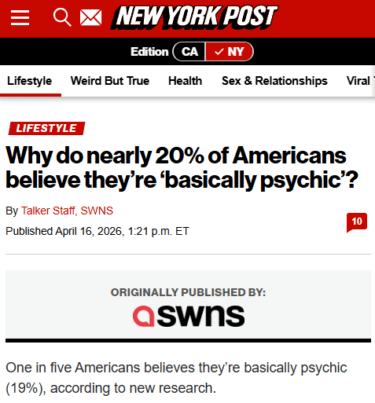
There’s one other telling piece of coverage of this story – it was given a lengthy article in the New York Post, the American newspaper that’s perhaps equivalent to the UK’s Daily Star or Daily Express, in that it’s rarely taken particularly seriously but is highly ‘tabloidy’. The only reason I highlight their article, headlined “Why do nearly 20% of Americans believe they’re ‘basically psychic’?”, isn’t so much for its content as for its byline. Because, while the article content is essentially a direct pull from the press release about this study, the byline is: “Talker Staff, SWNS”.
The Talker bit there refers to Talker Research, the company that created this survey. As for the SWNS, that would be South West News Service, the newswire owned by and operated in conjunction with 72 Point PR agency and OnePoll polling company. SWNS was the newswire that 72 Point bought when some journalists stopped directly accepting press releases from their PR company – so they bought a newswire, which now pushes out all the articles it used to produce, as well as press releases based on OnePoll surveys, which then get taken up by journalists who may not even notice they’re accepting the PR surveys they used to reject.
Which got me to wondering, who’s behind Talker Research? It’s a US-based polling company with offices in San Diego and Brooklyn. And they proudly proclaim that they offer users of their panel access to polls in return for “a virtual incentive usually related to the online activity they are engaging in”, applying checks to weed out those who they think look like bots, or are operating multiple accounts, and who fill in surveys unfeasibly quickly.
It all sounded very familiar, as it’s exactly the kind of polling company I’ve been writing about for more than 15 years. It sounded an awful lot like OnePoll, especially given the SWNS connection. Which probably isn’t a surprise, as Talker Research is rebranded arm of OnePoll US.
So, this has all just been a OnePoll story, in which they’ve pushed out a marketing survey to 2000 Americans and then farmed the results for anything they can use to generate some headlines to help put the US wing of their business on the map. And it worked, given that everywhere that reported on this story included a juicy link to the page on Talker’s website featuring the findings. Even the Guardian, with its tongue-in-cheek coverage, linked its readers to Talker’s website, doubtlessly juicing the business visibility in doing so – which, I’d argue, was the only real point to this marketing poll.
It’s why I think these types of stories are interesting: because the New York Post ran the story uncritically, reporting the shock finding that Gen Z are about as likely to believe in psychic ability as everyone else has always been in almost every poll that’s ever been conducted. And StudyFinds and the like reported this at face value, alongside reports from academic research into new treatments for diabetes – as if these have equal weight and importance. Meanwhile, the Guardian ascribed the apparent psychic ability to a heightened need to pay attention to the collapse of civil order during late-stage capitalism.
But, I would argue all of these outlets were equally wrong because, in reality, this was just an ad for a polling company, beset by all of the usual issues these polls have – from users being incentivised to be the first to finish responding, without really thinking too hard about their answers, to the issue of outliers in hard-to-reach niches spinning results into territories that make them hard to believe. Whether you engage with the narrative by affirming it, or engage with the narrative to doubt it, you’re still playing the same engagement game, and you’re sending traffic towards the company that produced it.
Do Gen Z believe they’re psychic? Do they believe it in levels that are remarkable compared to other age groups? Do they believe it more than their peers would have in past generations? I’ve no idea, and I don’t trust this advert for a polling company to tell me.