




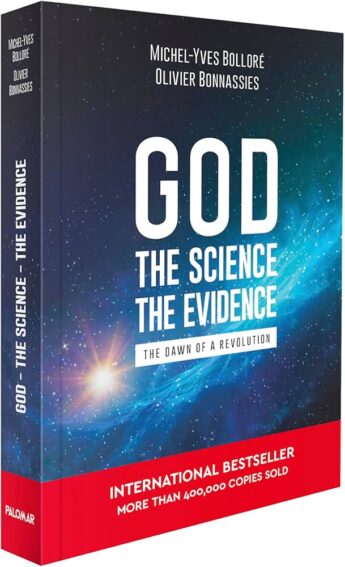
I wish I could say that my atheism was genuinely challenged by God: The Science, The Evidence, The Dawn of a Revolution, by Michel-Yves Bollore and Olivier Bonnassies. That it has forced me to reconsider my faith in materialism as a sufficient account of our world. I wish this was going to be a more dramatic review. “Die-hard atheist struggles with doubt after reading new apologetics” is the sort of headline that would almost certainly garner more attention.
Sadly, that is not the review I get to write. The truth is that this is a deeply frustrating book. It brings out the worst in me, specifically the part of me that wants to point out logical fallacies by name. Now, as the book frequently notes with ever increasing condescension, it is possible that my frustration arises from my fear of the strength of the arguments and my desire to resist them by any means necessary. However, a much more likely possibility is that the book suffers from all of the unfortunate hallmarks of intelligent design style apologetics, which arose as a deliberate strategy to get creationism taught in schools as a competing scientific theory. First and foremost, the book lures people in under false pretences, promising that:
The purpose of the book is not to militate for a particular religion, much less to engage in an analysis of the nature of God or his attributes. The goal of this book is to gather into one volume the most up-to-date rational arguments for the possible existence of a creator God.
Given that stated purpose, I think one can rightfully be frustrated when that pretence of pure rationality and theistic neutrality collapses into a kitchen-sink’s worth of Christian – and in some cases explicitly Catholic – arguments, and “evidence” for the existence of a pretty specific creator god. The book is divided into two parts – “evidence from within the sciences” and “evidence from outside the sciences” – ostensibly because it is valuable to cover all these bases, though in practice it reveals the true nature of their purpose, as the latter half compromises any credibility built up in the first half of the book.
Part one focuses primarily on the fact that our universe appears to have a beginning, and that the natural laws are “fine-tuned” in the ways needed for life to exist. This focus on cosmology is the cutting edge of ‘god of the gap’ arguments, though they do also drop in a chapter on the unlikely emergence of life from non-living things, because you gotta play the hits for the long-time fans.
Part two provides a far less focused analysis of “evidence from outside the sciences”, sacrificing time that could be better spent taking seriously philosophical objections and alternative explanations in order to explain how the Jewish people possess “a destiny beyond the improbable”, and how in 1917 Portugal a bunch of people really witnessed a miracle where the Virgin Mary promised that the sun would dance in the sky and then it did.
I want to be clear here, as an atheist of Jewish heritage it is extremely creepy when Christians suggest that my continued existence and my people’s impact on the world is evidence of a destined existence made possible by a god who cares specifically about my ethnic group, even though it’s also debatable if we’re hell-bound Christ-killers. On top of just being really weird, talking about the pervasiveness of Jewish influence in this way reinforces antisemitic conspiracy theories about global Jewry that has historically resulted in bad outcomes for my people.
I think it’s fair to say there is a reason the book is ordered this way, because if you opened with the creepy chapter about Jewish destiny or the weirdly specific chapter about a Catholic miracle, far fewer people would stick around for the science-based arguments. Having it anywhere in the book still counts strongly against the credibility of the overall project, though, as it suggests the authors are unreliable at assessing what constitutes evidence for the existence of a creator god, and are either unable or uninterested in sticking to the purpose they set for the book. Still, the best I can say about the book is that its structure provides a useful blueprint for understanding how intelligent design arguments function, and how they have evolved in response to pushback.
Some might see the book’s 600-page length as evidence of its thoroughness, but when you actually look at how that space is deployed, all one should be able to conclude is this is a textbook Gish-gallop. Within the part that is ostensibly just about scientific evidence, the authors devote hundreds of pages to irrelevant detail both about the early stages of the universe and about the history of political violence related to cosmological theories. On the scientific evidence side, all that matters for their argument is that the big bang arose from a singularity that was non-spatial and non-temporal, which makes it problematic to talk about anything happening “before” the big bang.
Even more tangential, the authors go into extensive detail about the persecution of scientists who questioned materialism and presented evidence for the big bang, which might be interesting to readers who want to learn about the politicisation of cosmological theory, but is completely irrelevant to assessing whether a creator god exists. Their stated justification for including this material as “evidence” is just that materialists must have been so aggressive in persecuting these scientists because they correctly recognised that this new cosmology provided strong evidence for the existence of god.

The authors don’t even consider the possibility that the materialist oppressors were simply wrong in their assessment of what the science implies about a creator god, and so their persecution of scientists was both intellectually and morally misguided. The result is more implicit skepticism that materialists are unlikely to give their arguments a fair reading.
Generally speaking, you can tell when supposed evidence is actually irrelevant to an argument, because it’s possible to concede every part of the evidence without being in any way pressured to accept the conclusion due to the existence of plausible alternative explanations. The same goes for all of the science that make up the bulk of the first 300 pages of the book: none of it actually forces anyone towards the conclusion they’re advancing, even in the thinnest sense of a creator god.
Conversely, the problem of evil, which even the authors acknowledge is “the philosophical argument that most strongly captures the public’s attention”, is dispatched in just five paragraphs, during which all evil is explained as “the consequence of the bad use that angels and men have made for their freedom”. As I’ve written at length, this is nothing more than the illusion of cosmic justice shielded from threat by the illusion of free will, a frequent move made by apologists seeking to shift blame from god to its creation. We’re told just a few pages earlier that free will is compatible with god’s divine foreknowledge because god is transcendent and can simply choose which things are matters of chance versus being determined by his will. None of this is explained, and any apparent contradictions are simply attributed to the unknowability of god’s nature, so no responses to this cosmic victim blaming are even considered.
It is also odd that any of this is included at all, since the problem of evil only matters if you’re trying to prove not only that an unmoved mover exists but also that it is benevolent, which is not included in the definitions of god provided in the book. For example, the authors initially say they won’t be analysing the features of God, which would make it very difficult for them to explain what sorts of things could count as evidence that such a being exists. So, instead, they explain that they are not intending to argue solely for “the concept of God within the Abrahamic religions, but rather to an entity that, unlike created beings… is the cause of its own existence.” Based on this, one would expect an argument for a very thin account of a creator god, and indeed in the index “God” is defined as “a being transcendent to our Universe, one who is eternal and all powerful, non-spatial, non-temporal, non-material, the first cause of all that exists”.
While it is never made clear why the creator god would need to be all powerful, rather than simply powerful enough to create a universe, this is generally speaking the sort of prime-mover entity one might hope to wring from the fact that the big bang occurred and maybe needed a non-temporal cause, if such a thing is even coherent. However, it is not the sort of entity that would have a weird fixation on the destiny of the Jewish people or would put on a light show for a field of people in 1917 Portugal. Nor is it the sort of benevolent and purposeful entity that the authors actually argue for in the second half of the book.
The authors’ biases impact more than just the style and use of polemical devices, as there are also parts of the book where they fail to accurately explain the concept in question such that unfamiliar readers are likely to be misguided and misinformed. The most glaring example of this was their account of the anthropic principle, where they fail to convey the original meaning of the term, and instead use it to effectively mean the opposite. The anthropic principle was originally proposed by Brandon Carter as an explanation for the “fine-tuning” of the universe, and essentially points out that we must necessarily observe a universe that supports life, because if it didn’t, we wouldn’t be there to observe it. So, even if it is the case that such a universe is extremely unlikely, the odds that we would exist in such a universe are always one. We may marvel at our luck, but since it is the result of a sort of cosmic observer bias, nothing empirical follows from it – particularly not the need for an intelligent designer who wanted us to exist.
However, if you only learned about the anthropic principle from reading this book, you might infer the principle means the opposite. The reason is that the authors treat a book by John D. Barrow and Frank Tipler as “the standard reference work on the subject”, even though critics have pointed out that Barrow and Tipler depart significantly from Carter’s original account in order to try to build a case for intelligent design. The centring of Barrow and Tipler results in an analysis that will mislead readers unfamiliar with the debate, and further undermine the book’s credibility with those who have already seen the anthropic principle evoked as a rebuttal to the argument from fine-tuning. Even if none of this is meant to be duplicitous, it means that the anthropic objection to their whole approach is never given serious consideration.
It is around this point that I honestly struggle with whether it is valuable to continue the extensive litany of remaining criticisms, which is part of how Gish-gallop works: it exhausts the debunker as well as the debunker’s audience, forcing them to choose between letting so many problems go unremarked, or death-marching their way through every leap of logic or questionable insinuation.
Is it worth noting, for example, how they lay out a false dichotomy between “materialism” and “the existence of a creator god”, and then defend that false dichotomy by acknowledging that some people believe in “spirits” unrelated to a divine creator before dismissing those alternatives because they are “rarely rationally articulated”, before then going on to argue for an incomprehensible creator god? Or that it’s both western-centric and false to claim that Plato first argued the existence of a supreme being, when the Brahman of the Upanishads was there at least a century earlier? Or, perhaps most embarrassingly, that the book makes a big deal out of an endorsement from Robert Wilson, who has since had to explain that he was only shown the first half of the book and that, with what he now knows about part two of the book, he should have refused to endorse it.
It certainly won’t be surprising to learn there is a chapter arguing that god is necessary for there to be objective morality, which I have argued elsewhere is just the sophisticated metaethics version of claiming that atheists are immoral and untrustworthy. Given how atheists are portrayed throughout the book and the lack of consideration of actual responses by philosophers on the necessity of god as a source of morality, the authors certainly leave the impression that atheists are at best incoherent when they embrace objective morality alongside materialism, and at worst cannot be trusted.
Setting aside all of the red herrings and non sequiturs, the simple reason I find cosmological arguments for god so uncompelling is that they put in so much effort to argue that everything must have a cause, and then claim to solve the problems that generates by simply positing the existence of a being that can actually be uncaused, because its “transcendent” and so gets to be an exception to all the rules that apply to everything in our universe in a way we can’t ever question or comprehend. That’s no different from just giving up on the problem entirely for a deeply unsatisfying answer, the epitome of looking at a real mystery and then just throwing something even more mysterious at it as an explanation. If you convince me that things need causes, of course I’m going to want to understand why god doesn’t need a cause, and I’m going to find “it’s a mystery” to be an unsatisfying answer. It doesn’t move the ball down the field; it just removes it from the field and ends the game.
One final concern to highlight in all of this is the role that books like this play in the larger intelligent design project of getting Christian leaning creationism taught in science classes as “just another theory”. While there is genuine debate about what should count as a scientific theory worth including in a science curriculum, ham-fisted attempts like this to use intelligent design as a thinly veiled cover for pushing Catholic or Christian apologetics are easy to dismiss. Far from being an illuminating, much less likely account of the universe, they clearly fall on the wrong side of separation of church and state.
In conclusion, the problem with this book is not that the authors have a viewpoint and argue for it; it is that they initially obscure their true intentions in order to build credibility, before pivoting to Catholic apologetics. Far from building a credible case for intelligent design, the bait and switch between a creator god and Catholic Jesus laid out in this book is both frustrating to read and a red flag about the overall project. If this is book is truly a comprehensive survey of what intelligent design has to offer, we can all remain comfortably unmoved.
God: The Science, The Evidence, The Dawn of a Revolution by Michel-Yves Bollore and Olivier Bonnassies, is out now, recently translated into English.